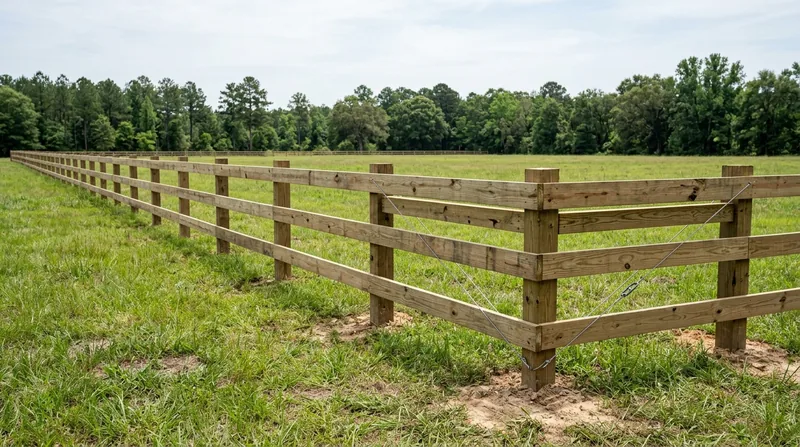




Farm fence installation in Columbia demands more than standard residential fencing work. The Midlands around Columbia, Lexington, and Irmo support working agricultural ground and serious horse operations, where fencing must stand up to livestock pressure, equipment gates, and the daily wear of a functioning farm. Whether you're running cattle, horses, or managing field boundaries on acreage in Richland or Kershaw County, the fence you build has to hold. We've been installing and repairing ranch and farm fencing since 2013, and we understand the difference between a decorative fence and one that works for a living.
Why Farm & Ranch Fencing Matters in Columbia's Agricultural Communities
Farm and ranch fencing in the Columbia area serves a practical purpose: it contains livestock, divides pasture, protects equipment, and marks property boundaries across working ground. A fence that fails under livestock pressure costs time, money, and potentially a lost animal. The soil, drainage, and exposure vary across the Midlands, and so does the fencing strategy. A split rail fence works beautifully on some properties and settles differently on others. A no-climb horse fence stops a determined animal; field wire and pipe fencing handle the wear of daily farm operation.
- We install split rail fence for clean lines and traditional ranch aesthetics on properties around Columbia and Lexington.
- No-climb horse fence prevents hooves from catching and keeps horses safely contained on pasture ground.
- Pipe fencing and field wire handle livestock pressure and last through years of equipment and animal contact.
- Barbed wire and post-and-wire combinations work for boundary definition and cost-effective acreage management.
- Equipment gates and entry gates are sized and hinged for tractors, trailers, and daily farm access.
Choosing the right fence type depends on what you're containing, how many linear feet you need to cover, and what your budget will support over time.
Key info: Properties in Kershaw County around Camden and throughout Richland and Lexington require fencing that earns its keep. We work with existing surveys and install on the line you identify. South Carolina law requires a 811 utility locate before any post holes are dug, and we handle that step before breaking ground.
For detailed information on what fencing codes and setbacks apply to your property, contact the Columbia city building department or your county planning office. Rules vary across Greater Columbia jurisdictions.
How We Build Farm & Ranch Fencing Near Me: Our Process in Columbia
Our approach to farm and ranch fencing starts with understanding your land, your animals, and your long-term needs. We don't sell you more fence than you need, and we don't cut corners on posts, hardware, or installation depth. A fence post set in concrete at 36 inches holds differently than one tamped into soil, and that choice affects how long your fence survives livestock pressure and weather. We walk your fence line, talk through your goals, and build a plan that makes sense for your acreage.
- We meet on your property, locate the fence line using your existing survey, and confirm any HOA or municipal setback requirements.
- We call 811 for utility locates and wait the required time before digging any post holes.
- We set posts at the proper spacing and depth, using concrete on posts that will carry livestock pressure or gate load.
- We install rails, wire, or panels according to the fence type you've chosen, ensuring proper tension and alignment.
- We hang gates square, level, and self-closing where you need them, and test every hinge and latch before we leave.
The result is a fence that does its job reliably and doesn't need constant repair.
Example: A property in West Columbia with 10 acres and three pastures needed split rail fencing for visual appeal and no-climb horse fence for the working paddock. We installed 800 linear feet total, set all posts in concrete to handle the daily wear, and hung two equipment gates with heavy-duty hinges and self-closing latches. The whole job took four days and has held up for years without sagging or settling.
If you're dealing with a fence that's already failing, we also handle fence repair and post replacement on acreage. Sometimes the better choice is to reinforce what you have rather than start over.
Farm & Ranch Fencing Methods and Materials
The fence type you choose depends on your livestock, your property layout, and your budget. Each method has real strengths and real trade-offs. We'll walk you through what makes sense for your ground and your animals.
| Fence Type | Description | Best For |
|---|---|---|
| Split Rail | Traditional post-and-rail construction, typically three or four rails, posts set 8 feet apart, cedar or pressure-treated wood. | Decorative ranch boundaries, horse properties, acreage definition where containment is secondary to appearance. |
| No-Climb Horse Fence | Welded wire mesh (2x4 inch or 2x6 inch opening) stretched tight between posts, prevents hooves and legs from catching, typically 4 to 5 feet tall. | Horse pastures, working paddocks, any situation where animal safety and containment are the priority. |
| Pipe & Post Fence | Steel pipe or tubing welded or bolted between posts, galvanized or powder-coated, extremely durable and low-maintenance. | High-traffic areas, equipment gates, livestock containment where strength and longevity outweigh aesthetic concerns. |
| Field Wire & Barbed Wire | Tension-wire fencing stretched between posts, field wire for general containment, barbed wire for cattle, cost-effective per linear foot. | Boundary definition, large pasture areas, cattle operations, acreage where budget per foot is a primary concern. |
| Equipment & Farm Gates | Heavy-duty hinges, self-closing and self-latching hardware, sized for tractors and trailers, typically 10 to 16 feet wide. | Pasture entry, equipment access, any gate that handles daily farm traffic and must stay secure without manual closing. |
Each method carries real advantages. A split rail fence on a property in Irmo looks beautiful and suits the landscape, but won't contain a determined horse. No-climb fencing stops animals cold and is almost invisible from a distance. Pipe fencing costs more upfront but lasts decades with almost no maintenance. Field wire is the most economical choice for marking boundaries on large acreage. We help you match the fence to your actual need, not to what's trendy.
Farm & Ranch Fencing Cost in Columbia: What to Expect
Farm and ranch fencing costs in the Columbia area start at approximately $12 per linear foot for basic split rail or field wire installation, and can range upward depending on several real factors. A split rail fence with pressure-treated posts and cedar rails runs higher than field wire. No-climb horse fencing with quality welded mesh and proper tension hardware costs more per foot than simple post-and-rail. Pipe fencing, because it's steel and requires welding or bolting, commands a premium. Gates add to the total, and so do terrain challenges like rocky soil, existing vegetation, or steep slopes that slow installation.
Access matters too. A property in Cayce with easy equipment access and clear ground moves faster than one in Blythewood where trees line the fence line and the crew has to hand-dig every post hole. Posts set in concrete cost more than tamped posts, but they hold longer under livestock pressure. A 500-linear-foot job on flat, clear ground with no gates might cost $6,000 to $8,000. A 1,000-linear-foot property with equipment gates, rocky soil, and trees could run $15,000 to $25,000 or more.
The best way to know what your job will cost is to get two or three estimates. We offer free estimates with no obligation, and we respond within 24 hours. Call us at (839) 250-4891, and we'll come walk your fence line and give you a real number based on what you actually need.
For more details on pricing across all our services, visit our pricing page.
What to Look for When Hiring a Farm Fence Contractor Near Me in Columbia
Hiring the right contractor for farm and ranch fencing is about more than price. You're investing in a fence that has to work reliably for years, and that means working with someone who knows the craft, understands your animals and your land, and stands behind the work. Here's what matters when you're evaluating contractors in the Columbia area.
- Verify that the contractor is fully insured and can provide a certificate of insurance before work starts.
- Ask for references from farm and ranch properties they've fenced in the past five years, and call at least two to ask how the fence has held up.
- Confirm that they understand 811 utility locates and will call before digging post holes.
- Check whether they're an AFA Member Installer (American Fence Association), which signals training and professional standards in the trade.
- Get a written estimate that breaks down labor, materials, posts, hardware, and gates separately so you know what you're paying for.
- Ask about their warranty on posts and hardware, and what they guarantee if a fence settles or sags within the first year.
- If your property is in an HOA community or subject to deed restrictions, confirm that the contractor will verify height, material, and color rules before you commit.
We've been installing farm and ranch fencing in Columbia, Lexington, Irmo, and throughout the Midlands since 2013. We're fully insured, we're AFA Member Installers, and we stand behind every fence we build. If you're ready to talk about your property, contact us for a free estimate.
Farm & Ranch Fencing in Columbia: Pricing Guide
| Service | Price | Details |
|---|---|---|
| Split Rail Fence | Starting at $12/ft | Pressure-treated posts and cedar rails, posts set 8 feet apart, basic installation on level ground with no trees |
| No-Climb Horse Fence | Starting at $15/ft | Welded wire mesh, 4 to 5 feet tall, quality tension hardware, posts set in concrete for livestock pressure |
| Pipe & Post Fencing | Starting at $18/ft | Galvanized steel pipe, welded or bolted construction, extremely durable, minimal maintenance over decades |
| Field Wire & Barbed Wire | Starting at $8/ft | Tension-wire installation, boundary definition, cost-effective for large acreage, posts typically 12 feet apart |
| Equipment & Farm Gates | Starting at $800 | Heavy-duty hinges, self-closing hardware, sized for tractors and trailers, 10 to 16 feet wide, price varies by size and material |
| Free Estimate | No obligation | We walk your fence line, review your needs, and provide a written estimate within 24 hours at (839) 250-4891 |
Indicative pricing, the exact cost depends on square footage, finish, and site access. Free personalized estimate within 24h at (839) 250-4891.


